Generative Engine Optimization: A Practical GEO Plan
Generative engine optimization is the work of getting your brand cited and described accurately in AI answers. This guide gives marketers new to GEO a step-by-step plan, from baseline checks to measurement.
Searvia · 10/26/2026 · 6 min read
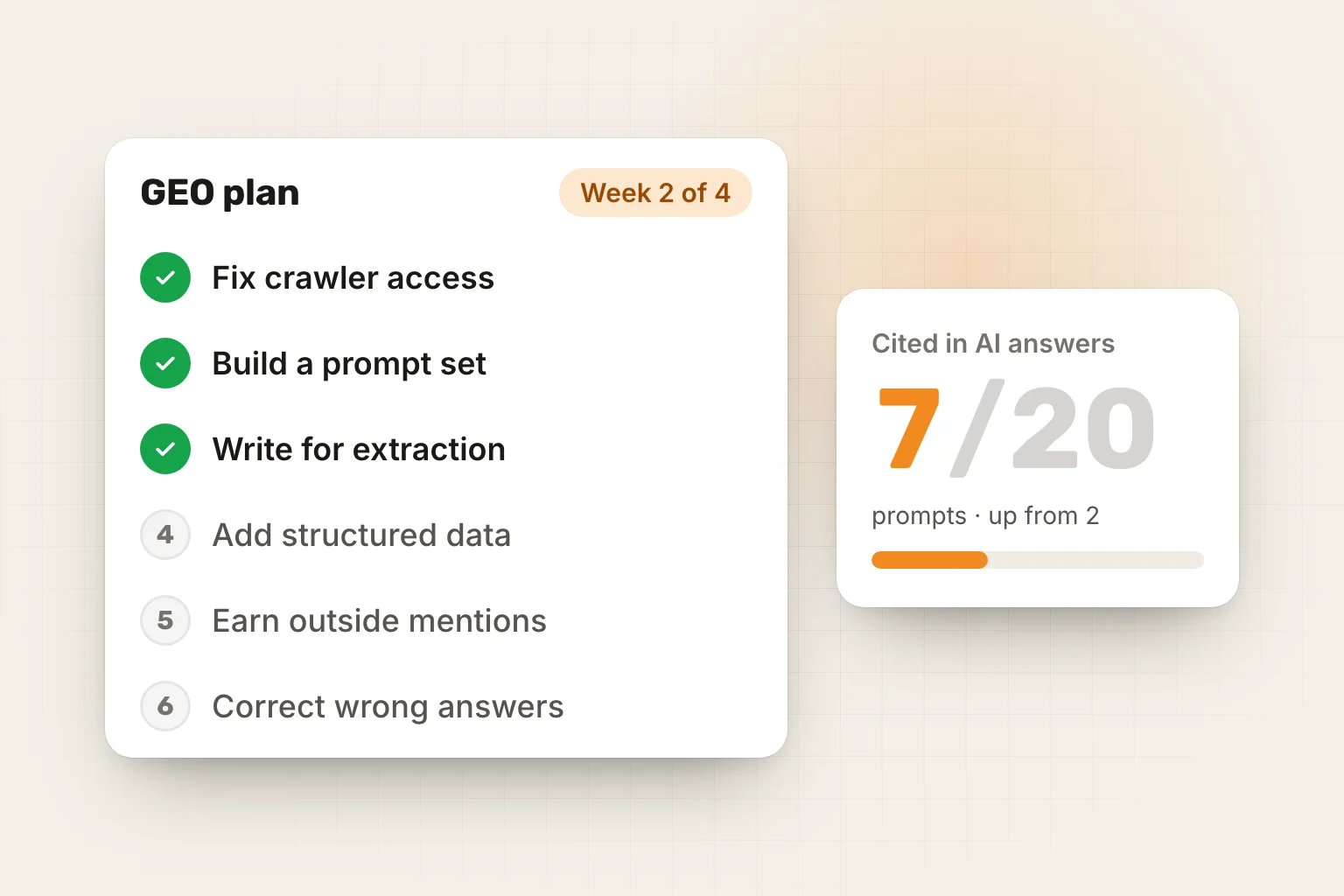
Generative engine optimization (GEO) is the practice of making your brand and content easy for AI systems like ChatGPT, Gemini, Perplexity, Claude and Google's AI features to find, trust, cite and describe correctly. It builds on SEO rather than replacing it: the same foundations apply, but you measure success by whether you appear in answers, not only by rankings and clicks.
This guide is a plan for marketers who are new to GEO: what it is, what actually moves the needle, what to skip, and how to run it in a few weeks.
What GEO is (and the names you will see)
The term was introduced in a 2023 research paper and later presented at the KDD 2024 conference. Since then, several labels have spread for overlapping work: answer engine optimization (AEO), LLM optimization (LLMO), AI optimization (AIO) and simply "AI SEO". There is no agreed definition, so do not get stuck on vocabulary.
Google's own guidance for its generative AI features takes a clear position: optimizing for generative AI search is still SEO. Those features rely on Google's core ranking and quality systems, using techniques such as retrieval-augmented generation (pulling relevant pages from the index to ground an answer) and query fan-out (running several related searches for one prompt). So a page that is not indexed or not useful is unlikely to be used.
A practical working definition: GEO is SEO plus brand presence plus measurement of AI answers.
How AI answers pick sources
AI systems generally combine two things:
- What the model learned in training. Hard to influence quickly. It reflects how widely and consistently your brand is described across the web.
- What it retrieves at answer time. Search-connected assistants fetch pages, then summarize them. This is where most of your near-term influence lies.
For the retrieval part, the pages that get used tend to be crawlable, clearly structured, specific, current and corroborated by other sources. Answers also vary by platform and by prompt wording, and they can change between runs, so treat any single result as a sample, not a verdict.
SEO vs GEO at a glance
| Area | Traditional SEO | GEO |
|---|---|---|
| Goal | Rank and earn clicks | Be cited, recommended and described accurately |
| Unit of success | Position for a keyword | Presence in answers for a set of prompts |
| Main inputs | Content, links, technical health | Same, plus consistent brand mentions across third-party sources |
| Measurement | Rank, impressions, clicks | Share of answers, citation, sentiment, accuracy, AI-referred visits |
| Volatility | Moderate | High: varies by platform, prompt and run |
A practical GEO plan
Step 1: Fix access and technical basics
If crawlers cannot reach you, nothing else matters.
- Check that your key pages are indexable and load fast. Our technical SEO audit checklist covers priorities, and the Core Web Vitals guide covers speed.
- Decide deliberately which AI crawlers to allow. Search-oriented bots and training bots are different, and blocking the wrong one can remove you from answers. See how to control AI crawlers and test your rules with the free robots.txt checker and AI crawler checker.
- Make sure important content is in the HTML, not hidden behind scripts, logins or tabs that never render.
- Optionally add an llms.txt file. Treat it as a low-cost extra, not a ranking lever.
Step 2: Build a prompt set before you change anything
List 20 to 40 prompts your buyers would really ask an AI assistant. Mix:
- Category prompts: "best project management tool for small agencies"
- Comparison prompts: "X vs Y for freelancers"
- Problem prompts: "how do I stop invoices going to spam"
- Brand prompts: "is [your brand] any good?"
Run each across at least two or three assistants and record: are you mentioned, in what position, with what tone, which sources are cited, and which competitors appear. This is your baseline. Without it you cannot tell whether anything worked.
Step 3: Write for extraction, not for show
AI systems favor pages that answer the question directly and add something specific.
- Open with a 2–3 sentence answer, then expand.
- Use headings phrased like real questions, followed by a direct answer.
- Prefer concrete detail: named criteria, steps, examples, tables, real numbers you can verify. Generic summaries add nothing a model cannot produce itself; Google calls this "commodity" content.
- Show who wrote it and why they are credible. Cite primary sources.
- Keep key facts (pricing, specs, dates) current and consistent across your site.
Step 4: Add structure that removes ambiguity
Use schema markup for organization, product, article, FAQ-style content and local details where it matches what is on the page. Validate it with the schema markup checker. Clean meta tags and consistent naming help systems understand what each page is.
Step 5: Earn mentions beyond your own site
AI answers lean on what multiple independent sources say about you. Work on:
- Reviews and profiles on the sites buyers and journalists actually use.
- Honest comparison and "best of" coverage in your category.
- Community discussion, partner pages, podcasts, digital PR with a real angle.
- A consistent description of what you do, in the same words, everywhere.
If you are a local business, an accurate Google Business Profile matters for local AI answers too.
Step 6: Correct what AI gets wrong
If an assistant states wrong pricing, features or locations, find the likely source (an outdated page, a third-party listing, a forum thread) and fix it at the source. Publish a clear, dated page that states the correct fact. There is no form to submit to "edit" a model, so correcting the sources is the lever.
What to measure
Rankings alone cannot describe GEO. Track a small set:
- Mention rate: the share of your prompts where you appear.
- Share of voice: your mentions versus named competitors.
- Tone and accuracy: how you are described and whether the facts are right.
- Cited sources: which URLs are used, so you know where to invest.
- AI-referred visits and conversions: filter analytics for referrals from AI assistants. Expect small volumes today and incomplete attribution, since many AI-influenced visits arrive as direct or branded search.
- Google's AI features: Search Console reporting includes this traffic within overall search performance, so watch impressions and clicks on question-style queries.
Re-run your prompt set on a fixed schedule, such as monthly, and look at trends across several runs rather than reacting to one answer. If you would rather not do it by hand, tools such as Searvia's AI visibility checker can check whether assistants recommend your brand; see also AI visibility tracking.
What not to do
- Do not chase tricks. Hidden text, prompt-injection snippets and mass-produced pages risk hurting you in search and are not a durable strategy.
- Do not rewrite your whole site first. Fix access, then improve the pages that already matter.
- Do not abandon SEO. Retrieval-based answers draw on search indexes, so classic SEO remains the foundation.
- Do not trust one screenshot. Answers shift by prompt, platform, location and time.
A four-week starter schedule
- Week 1: crawl and index checks, robots rules, baseline prompt run.
- Week 2: improve your five most important pages: direct answers, specifics, schema, authorship, fresh facts.
- Week 3: fill content gaps found in cited competitor sources; create one genuine comparison or data-backed resource.
- Week 4: outreach for third-party mentions, re-run prompts, log changes and decide what to repeat.
For a deeper look at citation tactics, read our guide to getting cited by AI search, and if you sell an app, see how to check if ChatGPT recommends your app.
Bottom line
GEO is a measurement and brand-consistency layer on top of solid SEO. Make your site accessible, answer questions better than anyone else, get described consistently by credible third parties, and track your presence across assistants over time. That is enough to start, and enough to outperform most competitors who are still guessing.
Frequently Asked Questions
- Is GEO replacing SEO?
- No. Google states that optimizing for its generative AI features is still SEO, and retrieval-based AI answers draw on search indexes. GEO adds brand-mention work and answer-level measurement on top of SEO.
- What is the difference between GEO and AEO?
- They largely overlap. AEO (answer engine optimization) is an older label often tied to featured snippets and voice answers, while GEO is usually used for ChatGPT, Gemini, Perplexity and AI Overviews. Usage varies and there is no agreed definition.
- How long does GEO take to work?
- Technical fixes and page improvements can show up in retrieval-based answers within weeks, but changes are noisy. Shifts in how models describe your brand depend on third-party coverage and take longer. Track trends over several monthly runs.
- How do I measure GEO performance?
- Build a fixed set of prompts, run them across several assistants, and record mention rate, share of voice versus competitors, tone, accuracy and cited sources. Add AI-referred visits in analytics, knowing attribution is incomplete.
- What is the best tool for generative engine optimization?
- It depends on the job. You need a crawler and audit tool for technical health, Search Console for Google's AI features, and an AI visibility tracker to monitor mentions across assistants. Start with free checks before paying for anything.