Which Brands Does Claude Recommend in Turkey? A 30-Question AI Visibility Study
We asked Claude, with web search on, 30 buying questions in Turkish across 10 sectors. It named a median of 8.5 brands per answer, cited 110 pages from 86 different sites, and only 10 of those pages belonged to a brand it recommended. Here is the data and what it means for AI visibility in Turkey.
Searvia · 10/27/2026 · 4 min read
When someone in Turkey asks an AI assistant "which bank has the best mobile app?" or "which cargo company should I use for my online shop?", the answer names a handful of brands and links a few pages. Which brands, and which pages? We asked Claude 30 such questions to find out.
The short version
- Claude named a median of 8.5 brands per answer and recommended 4 of them.
- It cited 110 pages from 86 different websites. No single site dominated: the most cited sites appeared only 3 times each.
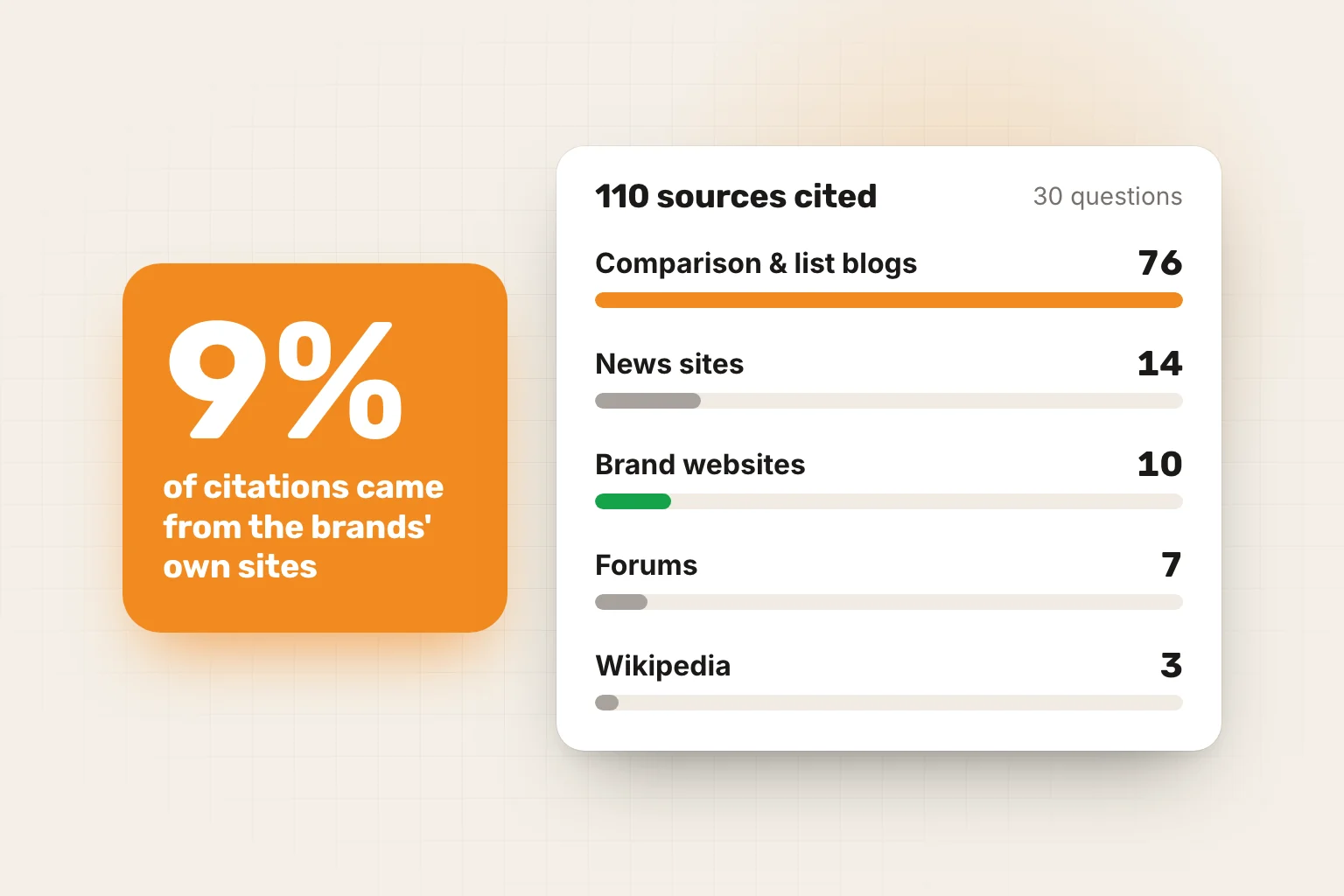
- Only 10 of the 110 cited pages (9%) belonged to a brand Claude recommended. The rest were comparison and list articles, news sites, forums and Wikipedia.
- In 26 of 30 answers Claude ran a single web search. Whatever ranked for that one search was, in practice, the whole source pool.
- In 2 of the 3 agency answers, the agencies whose own pages were cited were also recommended.
Method
On 27 October 2026 we asked Claude 30 questions in Turkish, three in each of 10 sectors: digital banking, online shopping, mobile operators, airlines, cargo, food delivery, home appliances, insurance, private hospitals and digital agencies. The questions were the kind people type when they are about to choose, for example "Türkiye'de en iyi kargo şirketi hangisi?" (which is the best cargo company in Turkey?) and "Türkiye'de kasko için hangi sigorta şirketini önerirsin?" (which insurer would you recommend for car insurance?).
We used the Claude API (claude-haiku-5-5) with web search on and the search country set to Turkey, the same way Searvia's AI visibility tracker asks Claude. Each question was asked once. A second Claude call listed every brand named in each answer, in order, and marked whether the answer recommended it. Citations are the links Claude returned with the answer. The whole study cost $0.42 in API usage.
This is a small, single-run snapshot of one assistant. It shows patterns; it is not a ranking of brands, and ChatGPT, Gemini or Perplexity may answer differently.
Who gets recommended
| Sector | Brands recommended most often |
|---|---|
| Online shopping | Trendyol, Hepsiburada, Amazon Türkiye (all three in 3 of 3 answers) |
| Mobile operators | Turkcell (3 of 3), Türk Telekom (2), Vodafone (1) |
| Airlines | Pegasus (3 of 3), Türk Hava Yolları and AJet (2 each) |
| Cargo | Yurtiçi Kargo and Aras Kargo (3 each), PTT Kargo, Trendyol Express, HepsiJET (2 each) |
| Home appliances | Arçelik, Bosch, Siemens, Vestel (3 each), Beko (2) |
| Insurance | Allianz and Türkiye Sigorta (3 each), Anadolu Sigorta (2) |
| Food and grocery delivery | Yemeksepeti (2), then Getir, Trendyol Yemek, Migros (1 each) |
| Digital banking | Enpara (3 of 3), then a different set in every answer (İşCep, Akbank, ING, Fibabanka, Ziraat and others) |
| Private hospitals | Acıbadem (2 of 3); Koç Üniversitesi, Medipol, Amerikan Hastanesi, Medical Park and Memorial once each; one answer recommended none |
| Digital agencies | Zeo and Mobitek (2 each), then a different set in every answer |
Two patterns stand out. In sectors with a few dominant national brands (shopping, mobile, cargo, appliances, insurance) the answers were stable: the same names came back in every answer. In fragmented sectors (hospitals, digital banking beyond Enpara, agencies) almost every answer named a different set. That is where AI visibility is still up for grabs.
Which pages Claude reads
Of the 110 cited pages:
| Source type | Pages | Examples |
|---|---|---|
| Comparison, list and review blogs, plus software vendors' blogs | 76 | eniyi.blog, eniyilerden.com, yenisiteler.org, parausta.com, eticaretradari.com |
| News and tech news | 14 | webtekno.com, onedio.com, finans.mynet.com, egundem.com |
| A recommended brand's own site | 10 | isbank.com.tr, enpara.com, allianz.com.tr, three agencies' sites |
| Forums and complaint sites | 7 | kizlarsoruyor.com, eksisozluk.com, sikayetvar.com, donanimhaber.com |
| Wikipedia | 3 | en.wikipedia.org |
The striking part is how small many of the cited sites are. Several are niche blogs that happened to rank for the exact search Claude ran. A page does not need to belong to a big publisher to be quoted; it needs to rank for the question and answer it clearly.
The agency example
The digital agency questions show the mechanism most clearly. In the first answer, two agencies that publish guides and lists on their own sites (Lein Digital and Prix Studio) were cited as sources and both were in the recommended list. In the third, the one agency whose page was cited (Protan) was also recommended. In the second answer the same two agency blogs were cited, but as sources for a list of other agencies. Apart from Zeo and Mobitek, the recommended agencies changed from one answer to the next.
One case does not prove a rule, but it matches how the answer is built: Claude searches, reads the top results, and names the brands those pages talk about. If your own page is one of those results, you are both the source and the subject.
What this means for brands in Turkey
- Rank for the buying question, not only for your brand name. Claude usually ran one search per question. Check which pages rank for "en iyi [kategori]" and "[kategori] önerisi" in Google Turkey; those are the pages the answer is built from.
- Be on the comparison pages that already rank. Most citations were third-party lists. Make sure you are on them, with current and correct facts (price, coverage, delivery time).
- Publish one honest comparison page yourself. Brands that had a page answering the question directly were the only brand sites cited.
- Do not ignore forums. Kızlar Soruyor, Ekşi Sözlük and Şikayetvar were cited. What people write there about you reaches the answer.
- Measure the same questions every week. One answer is noise. Track a fixed set and watch the rate move.
Check your own brand
You can run the same kind of check for free with the AI visibility checker, read the GEO guide for the full checklist, or track a fixed set of questions every week in ChatGPT, Perplexity, Gemini and Claude with Searvia's AI visibility tracker.
Frequently Asked Questions
- How was the study done?
- On 27 October 2026 we asked Claude (claude-haiku-5-5 through the Claude API, with web search on and the search country set to Turkey) 30 questions in Turkish: three buying questions in each of 10 sectors. Each question was asked once. A second Claude call listed every brand named in the answer and whether it was recommended. Citations are the links Claude returned with each answer.
- Does this tell us what ChatGPT or Gemini recommend?
- No. This is one assistant and one run per question. Other assistants use other search indexes and answer differently, and Claude itself can answer differently on the next run. Treat the numbers as a snapshot that shows patterns, not as a ranking of brands.
- Why are so few citations from brand websites?
- For questions like 'which is the best cargo company in Turkey', Claude searched once and mostly read comparison posts, list articles, news and forums that ranked for that search. Brand sites rarely publish a neutral comparison, so they are rarely the page that answers the question.
- What should a brand in Turkey do with this?
- Find the comparison and list pages that rank for your category's buying questions and make sure you are on them with accurate facts, publish a page on your own site that answers the comparison question honestly, and earn reviews and forum discussions in Turkish. Then measure the same questions every week.
- Can I get the raw data?
- Yes. Write to info@searvia.com and we will send the questions, answers, named brands and cited URLs as a spreadsheet.