GEO vs SEO: What Changes When AI Answers the Question
GEO and SEO share most of their foundations, because AI assistants pick sources from pages that already rank. The difference is what happens after retrieval: whether your page is easy to quote and your brand easy to recommend. Here is a side-by-side comparison and a work order that covers both.
Searvia · 10/27/2026 · 4 min read
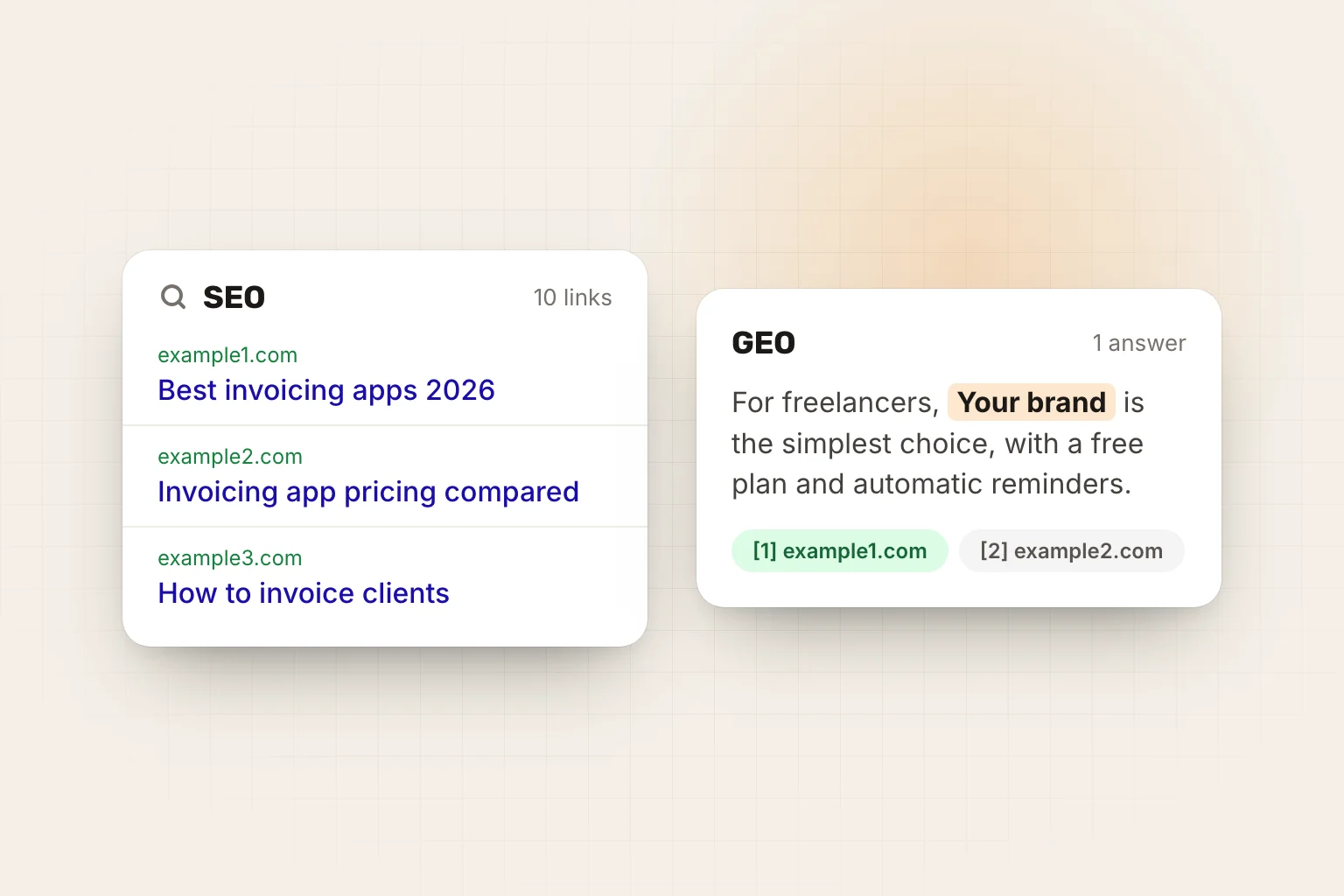
GEO and SEO are not rivals. AI assistants that search the web build their answers from pages that already rank, so most SEO work carries straight into GEO. What changes is the last step: in a results page, the user picks a link; in an AI answer, the model picks the sources and names the brands for them.
The short answer
SEO (search engine optimization) is the work of getting a page ranked in Google or Bing so people click it.
GEO (generative engine optimization) is the work of getting your page quoted and your brand recommended inside an answer written by ChatGPT, Gemini, Perplexity, Claude or Google AI Overviews.
The first is a prerequisite for the second. A page that is not crawled, indexed and relevant for the query never reaches the model.
Side by side
| SEO | GEO | |
|---|---|---|
| Where you appear | A list of ten links | Inside one written answer, with a few cited sources |
| Who decides | The ranking algorithm, then the user's click | The ranking algorithm, then the model's choice of passages and brands |
| Unit of success | A page's position | A brand mention, a citation, a recommendation |
| What wins | Relevance, links, technical health, intent match | All of that, plus quotable facts, consistent brand descriptions and mentions on other sites |
| How you measure | Rank tracking, Search Console, analytics | Mention rate, citation rate and share of voice across repeated questions, AI referrals, AI crawler logs |
| How stable | Positions move slowly | Answers change from run to run |
What stays the same
- Crawling and indexing. Google states that AI Overviews and AI Mode have no extra requirements beyond normal Search eligibility. If Googlebot cannot index the page, it cannot appear there either.
- Relevance to the real question. Assistants turn one question into one or more searches. The pages that rank for those searches form the candidate pool.
- Authority. Links and mentions from trusted sites still decide which pages rank, and pages that rank are the ones that get read.
- Speed and clean HTML. Assistants fetch pages under time limits. Slow or script-only pages are skipped.
What changes
1. Being retrieved is not enough
In a results page, ranking fifth still gets some clicks. In an AI answer, the model reads several pages and quotes only some of them. A page can be read and still lose to a competitor's page that states the fact more clearly. Put the answer to the page's main question in its first two sentences, with specific numbers, prices, dates or limits.
2. The brand matters more than the page
Assistants recommend brands, not URLs. They name the brands that appear repeatedly across the pages they read. That is why being listed on the third-party comparison and "best X" articles that rank for your category often matters more than your own page ranking. In our study of 30 buying questions asked to Claude in Turkey, only 10 of the 110 cited pages were the recommended brands' own sites.
3. Crawler access has new names
AI search uses its own crawlers. OpenAI separates OAI-SearchBot (ChatGPT search) from GPTBot (training), and other providers do the same. Many sites block these by accident through a CDN or firewall bot setting. You can allow search crawlers while still opting out of training.
4. Tricks age badly
Keyword stuffing did not help in the original GEO research and performed worse than the baseline on Perplexity. Hidden instructions aimed at AI models are treated as spam. The methods that held up were adding statistics, quotations and cited sources: content that is easier to verify.
5. One measurement proves nothing
Each AI answer is generated fresh. Measure a fixed set of questions on a schedule and track rates, not single screenshots.
A work order that covers both
- Fix access. Make sure Googlebot, Bingbot, OAI-SearchBot, PerplexityBot and Claude's search crawler can fetch your key pages, and that the main text is in the server HTML. The free AI search readiness checker tests this.
- Match the buying questions. List the questions customers ask before they choose, then make sure one page on your site answers each of them directly.
- Make pages quotable. Answer first, then explain. Use tables for comparisons, show the author and last-updated date, cite sources.
- Describe the brand the same way everywhere. Site, structured data, directories and profiles should state the same name, category and core facts.
- Get on the pages that rank. Find the comparison and list articles ranking for your category and earn a place on them with accurate facts.
- Measure both. Track rankings for your keywords and track mentions and citations for your questions. The GEO guide has the full 15-point checklist.
When to focus on which
If your pages are not ranking at all, SEO comes first; GEO has nothing to work with yet. If you rank well but AI answers name competitors, GEO is the gap: look at which pages the assistants cite and why they quote them instead of you. Searvia tracks both in one project: keyword rankings on Google, the App Store and Google Play, and weekly AI visibility in ChatGPT, Perplexity, Gemini and Claude.
Frequently Asked Questions
- Is GEO the same as SEO?
- No, but they overlap. SEO gets a page into the search results. GEO (generative engine optimization) gets that page and your brand used inside an AI-written answer in ChatGPT, Gemini, Perplexity, Claude or Google AI Overviews. Most AI answers are built from pages that rank, so SEO is the foundation and GEO adds work on top of it.
- Does GEO replace SEO?
- No. Google says there are no extra technical requirements for appearing in AI Overviews or AI Mode beyond being eligible for normal Search. If your pages are not crawled, indexed and relevant, they never enter the pool an AI answer is built from.
- What is different about measuring GEO?
- SEO is measured with rankings, impressions and clicks. GEO is measured with how often AI answers mention you, link to you as a source and recommend you over competitors, across a fixed set of questions asked repeatedly, because each answer is generated fresh.
- Should a small business start with SEO or GEO?
- Start with the shared foundation: crawlable, fast pages that answer real questions, a complete Google Business Profile and reviews. Then add the GEO-specific steps: allow AI search crawlers, put concrete facts at the top of key pages and get listed on the comparison pages that rank for your category.